

It’s not about how badly you were hurt. It’s about proving you were injured and that someone else was at fault.
Every year, millions of Americans are seriously hurt in slip and fall accidents. Some break a hip. Others suffer traumatic brain injuries. A few walk away with scrapes and bruises that seem minor at first but develop into chronic pain weeks later. Regardless of severity, the question is always the same: Can you prove it wasn’t your fault?
That is the core of any slip and fall personal injury case. Many people mistakenly believe that injury severity makes or breaks their claim. In reality, the key is demonstrating two things: that you were objectively injured, and that the property owner’s negligence, not your own actions, caused the accident. Whether you are a commercial truck driver hurt at a loading dock, a shopper injured in a store, or a visitor who slipped on an icy walkway, the legal framework applies the same way.
Key Statistics on Slip and Fall Accidents
According to the National Safety Council (NSC), slip and fall accidents account for more than one-third of all preventable nonfatal injuries in the U.S. In 2022, slips, trips, and falls resulted in 46,653 deaths in occupational and non-occupational settings combined.
The Bureau of Labor Statistics (BLS) reports that slips, trips, and falls led to 450,540 work injuries and 865 work-related deaths in 2022, accounting for approximately 15% of all workers’ compensation claims.
What Do You Need to Prove in a Slip and Fall Claim?
Winning a slip and fall case is not about the size of your bruise or the number of stitches you received. It is about meeting the legal burden of proof. In every premises liability case, the injured person (the plaintiff) must demonstrate four essential elements.
-
Duty of care:
The property owner owed you a legal obligation to maintain a reasonably safe environment. If you were a customer in a store, a guest in a building, or a worker at a commercial property, this duty almost always applies.
-
Breach of duty:
The property owner failed to uphold that obligation. Perhaps they neglected to clean a spill, fix a broken handrail, repair an uneven walking surface, or post adequate warning signs about a known hazard.
-
Causation:
The breach of duty directly caused your fall and resulting injuries. Your attorney must demonstrate a clear link between the dangerous condition and your accident. As noted by Nolo’s legal guide on slip and fall fault, proving causation often hinges on whether the property owner had “notice” of the danger, either actual or constructive.
-
Damages:
You suffered real, measurable harm as a result. This includes medical expenses, lost wages, pain and suffering, and other losses that can be documented. Understanding how to prove liability in injury cases follows a similar structure, whether the accident involves a truck collision or a wet floor.
Does the Severity of My Injury Matter in a Slip and Fall Case?
This is one of the most common misconceptions in personal injury law. Many people assume they do not have a valid claim because their injury seems “minor.” Others believe that a devastating injury automatically guarantees a large payout. Neither assumption is accurate.
What matters legally is that you can show you were objectively injured as a direct result of someone else’s negligence. A sprained wrist with documented medical treatment and proof of a hazardous condition can be a stronger case than a broken leg where the plaintiff cannot demonstrate the property owner’s fault.
That said, the value of a slip and fall settlement does correlate with the severity of injury, the cost of treatment, and the long-term impact on your quality of life. According to industry data, minor injury cases with weak evidence often settle for under $10,000, while strong negligence claims with serious injuries can reach well into six figures.
Watch: Did You Slip and Fall? Here’s What You Really Need to Prove
Attorney Roxell Richards breaks down the essential elements every plaintiff must establish in a slip and fall case, including why objective proof of injury matters more than the severity of your condition.
How Do You Prove a Property Owner Knew About a Dangerous Condition?
One of the most challenging aspects of a slip and fall lawsuit is proving that the property owner knew, or should have known, about the hazard that caused your fall. Property owners will almost always deny having any knowledge of the dangerous condition. This is where the legal concepts of actual notice and constructive notice become critically important.
Actual notice means the property owner or their employees were directly aware of the hazard. Evidence of actual notice can include prior incident reports, maintenance records showing previous complaints, surveillance footage capturing employees acknowledging the danger, or testimony from other visitors who reported the condition.
Constructive notice applies when the hazard existed long enough that a reasonably diligent property owner would have discovered and addressed it. The longer a spill sat on a floor, the stronger your argument that employees should have found it during routine inspections.
For commercial establishments, maintenance logs, inspection schedules, and employee protocols become invaluable evidence. A personal injury lawyer can subpoena these records during the discovery process, often revealing the property owner failed to follow their own safety procedures.
What Evidence Do I Need to Prove a Slip and Fall Case?
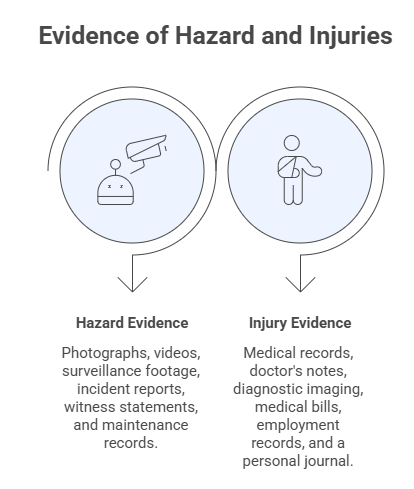
The strength of your slip and fall claim depends almost entirely on the quality of evidence you gather, ideally starting at the scene of the accident. Here is a breakdown of the types of evidence that can make or break your case:
Preserving this evidence quickly is essential. Surveillance footage is often overwritten within days. Hazardous conditions are cleaned up almost immediately after an incident. That is why it is so important to take immediate action after a slip and fall accident and document everything before leaving the scene.
Can I Still Win a Slip and Fall Case If I Was Partially at Fault?
Yes, in most states you can still recover compensation even if you share some responsibility for the accident. This principle is known as comparative negligence, and it is one of the most common defenses property owners use in slip and fall cases.
Under comparative negligence rules, your total compensation is reduced by the percentage of fault assigned to you. For example, if you were 20% responsible for your fall and the property owner was 80% at fault, you would receive 80% of the total damages awarded.
Some states apply a threshold: if you are found to be 50% or more at fault, you cannot recover any compensation. In Texas, which follows a “modified comparative negligence” rule, compensation is barred if you are more than 50% responsible. This is another reason having a strong legal advocate matters to counter allegations of comparative fault and protect your right to compensation.
Did you know? According to data from the National Safety Council, U.S. workers miss an average of 65 days of work due to slip and fall injuries. These accidents cost American workplaces a combined $11 billion annually in workers’ compensation claims alone.
Why Slip and Fall Cases at Commercial Properties Are Especially Complex

Commercial property owners often have dedicated legal teams and insurance adjusters whose sole purpose is to minimize payouts. They may argue the hazard was “open and obvious” or that your footwear was inappropriate. For commercial truck drivers and trucking company owners, hazards at loading docks, fuel stations, and rest areas are a real occupational risk, frequently involving diesel spills, wet surfaces, and uneven pavement. If you have been involved in a truck-related accident or injured at a commercial facility, establishing fault requires a thorough accident investigation.
Insurance companies are known for settling quickly with lowball offers, hoping injured victims will accept before understanding the full extent of their damages. Proven case results from experienced attorneys show that legal representation can significantly increase your compensation.
How Long Do I Have to File a Slip and Fall Lawsuit?
Every state imposes a deadline called the statute of limitations for filing a personal injury lawsuit. In Texas and California, you generally have two years from the date of the accident. If you miss this deadline, you lose your right to seek compensation entirely. For claims against government entities, the timeframe is often much shorter, sometimes requiring a notice of claim within six months.
Acting quickly is critical. An experienced personal injury attorney with free consultation can evaluate your case immediately, preserve evidence, and ensure you meet all filing deadlines.
Steps to Take Immediately After a Slip and Fall Accident
What you do in the minutes and hours after a slip and fall can dramatically affect your ability to secure compensation. If you or a loved one has been injured, take these steps:
-
Seek medical attention immediately.
Even if your injuries seem minor, get examined by a doctor. Some injuries, including concussions and internal injuries, may not show symptoms for days. A prompt medical evaluation creates a documented link between the fall and your injuries.
-
Report the incident.
Notify the property owner, store manager, or employer right away. Request a written incident report and ask for a copy.
-
Document everything.
Photograph the hazard, the surrounding area, your injuries, and your clothing. Record the date, time, and conditions.
-
Collect witness information.
Get names, phone numbers, and brief statements from anyone who saw the fall or the dangerous condition
-
Do not give recorded statements to insurance companies.
Adjusters are trained to minimize payouts. Consult with a personal injury lawyer before speaking with anyone from the opposing side.
-
Contact a slip and fall attorney.
A qualified personal injury lawyer can guide you through preserving evidence, negotiating a fair settlement, or taking your case to trial.
Frequently Asked Questions About Slip and Fall Cases
-
What do you have to prove in a slip and fall case?
To win a slip and fall claim, you must prove four elements: the property owner owed you a duty of care, they breached that duty by failing to address a hazardous condition, their negligence directly caused your fall and injuries, and you suffered measurable damages such as medical bills, lost wages, or pain and suffering. The key is establishing that the property owner knew or should have known about the danger and failed to take reasonable action.
-
Can I still file a claim if there was a “Wet Floor” sign?
A wet floor sign does not automatically shield a property owner from liability. The presence of a sign is one factor the court will consider, but it does not eliminate the owner’s duty of care. If the hazardous condition was not adequately remedied in a reasonable time, or if the sign was not placed in a visible location, the property owner may still be found negligent. Each case depends on the specific circumstances.
-
How long does a slip and fall lawsuit take to settle?
The timeline for a slip and fall settlement varies based on case complexity, injury severity, and liability disputes. Many cases settle within 3 to 18 months, though contested or complex claims can take longer. Only about 5% of slip and fall cases go to trial, as most are resolved through negotiation or mediation.
-
What if there are no witnesses to my slip and fall accident?
Even without eyewitnesses, you can still build a strong case. Surveillance footage, photographs of the hazard, your medical records, the incident report filed with the property owner, and maintenance records can all serve as powerful evidence. A personal injury attorney can subpoena security footage and other documentation during the legal discovery process to support your claim.
Slip and fall cases are won or lost based on one fundamental question: Can you prove that a property owner’s negligence caused your injury? Injury severity may influence your claim’s value, but it does not determine whether you have a case. What matters is evidence, documentation, and a clear demonstration that someone failed in their duty to keep you safe.
From gathering photographs at the scene to obtaining maintenance records through legal discovery, every piece of evidence strengthens your position. Whether your fall happened at a grocery store, a loading dock, or a public sidewalk, the legal framework remains the same. Do not let assumptions stop you from pursuing the compensation you deserve. With the right legal representation, even uncertain cases can result in meaningful recoveries.